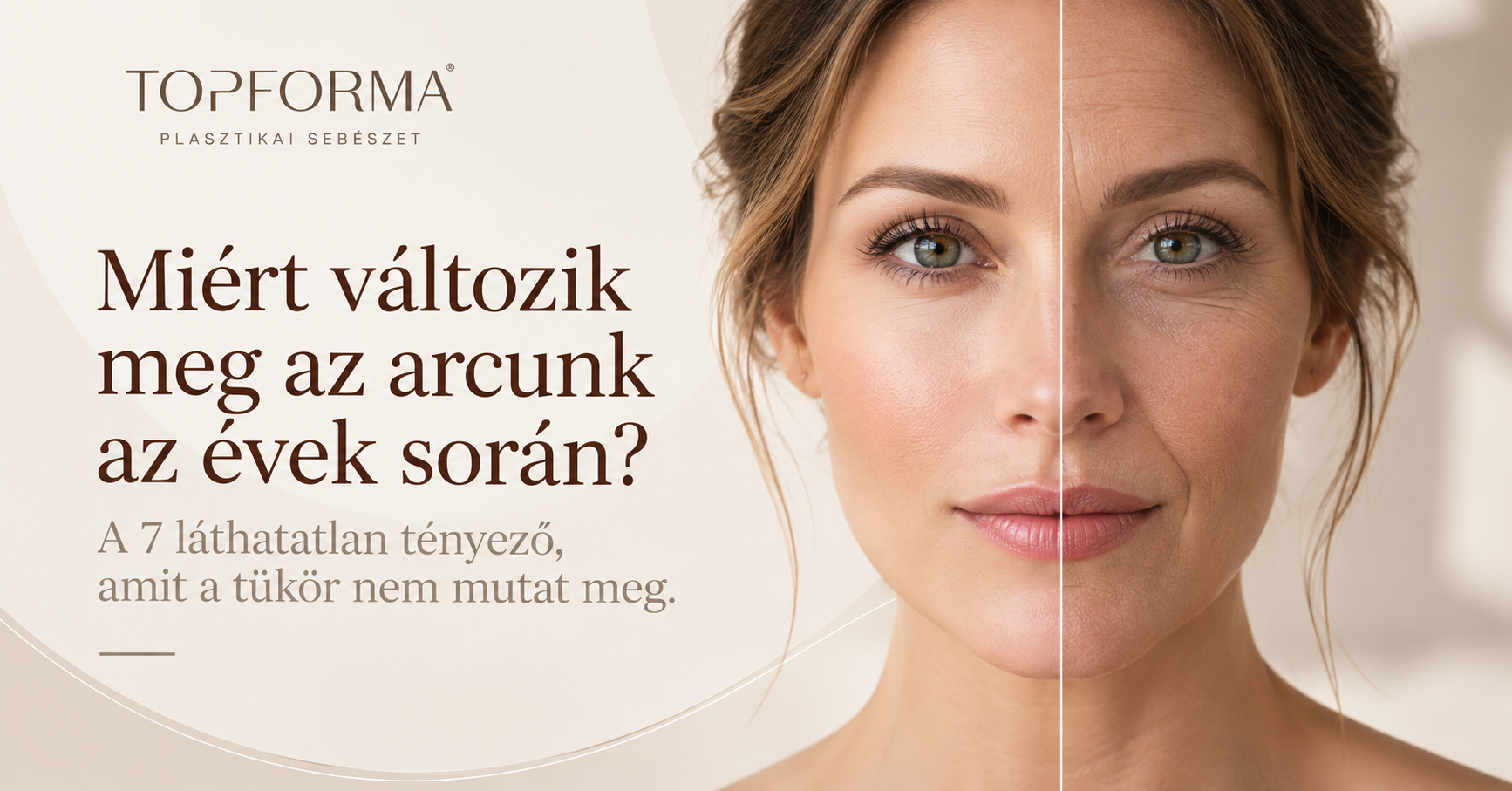
7 invisible factors that the mirror doesn’t show you.
There is that strange moment when someone takes out an old photograph of themselves and simply looks at it for a few seconds. Not necessarily because they see themselves as a completely different person. Quite the opposite: they recognize the same eyes, the same smile, and the same facial features. Yet something has changed.
Perhaps it is the area around the eyes. Perhaps the contours of the face. Maybe the jawline. Or perhaps the overall appearance of the face simply feels different.
At moments like this, it is easy to say: “A few wrinkles have appeared.”
But facial aging is a much more interesting process than that.
As the years pass, it is not simply that more wrinkles appear on our faces. The structure of the face gradually changes. The skin loses some of its properties, the amount and organization of collagen and elastin change, the soft tissues are remodeled, fat compartments may shift, and even the underlying bone structure can change.
In other words, when we look in the mirror, we are actually seeing the result of an extremely complex biological process.
And perhaps this is one of the most interesting aspects of facial rejuvenation: it is not just one thing that ages. The entire face changes, simply at different rates and at different times.
1. The Face Does Not Age Like a Photograph
If we place two photographs of the same person side by side, one from when they were twenty and another taken twenty years later, it is very easy to explain the difference simply by pointing to wrinkles.
Yet wrinkles are often only the visible result.
Imagine the face as a complex three-dimensional structure. It is not simply a thin layer of skin covering the skull. Multiple layers of tissue are positioned on top of one another, and each of them influences the appearance of the face.
The fatty tissue beneath the skin, for example, is not simply one homogeneous “cushion.” It consists of different fat compartments that can change with age. In some areas, volume may decrease, while in others certain tissues may become more prominent.
This is why someone may not necessarily look significantly more wrinkled, yet still feel that their face looks “more tired,” “heavier,” or simply different.
The change is therefore not necessarily found in a single wrinkle.
It is often found in the proportions.
2. Collagen Is More Than Just a Beauty-Industry Buzzword
Almost everyone has encountered the word collagen. It frequently appears in creams, dietary supplements, cosmetic treatments, and advertisements.
Collagen, however, is not interesting simply because it looks good in a cosmetic advertisement.
It is an important structural protein in the body and plays a role, among other things, in maintaining the structure of the skin.
As we age, collagen production and the structure of the skin change. The skin may gradually lose some of its elasticity and firmness, which can also affect the contours of the face.
This is one reason why, beyond a certain age, the problem is not necessarily just that “there are more wrinkles.”
The skin simply no longer behaves in exactly the same way it did before.
In our twenties, after making a facial expression, the skin quickly returns to its original state. Later in life, certain lines can become increasingly permanent.
And this is where an important distinction comes in.
Expression lines and other changes that develop over time are not necessarily the same phenomenon. For example, a line that appears when we smile is different from changes that occur when the support and volume of the facial tissues themselves are altered.
This is also why facial aging cannot simply be treated as a single problem.
3. Gravity Does Play a Role – But Not Everything Can Be Blamed on It
“Gravity pulls the face downward.”
It sounds convincing, and there is some truth to it, but the reality is more complex.
The changes that occur in the face over time are shaped by a combination of different factors. Gravity does affect the tissues, but it does not explain every change on its own.
Skin quality, the condition of connective tissues, changes in fat compartments, repeated facial expressions, UV exposure, lifestyle, and genetic factors can all play a role.
That is why two people of the same age can experience facial aging in very different ways.
For one person, lines may primarily appear on the forehead. For another, the skin around the eyes may become looser, while for a third person, changes in the contours around the jawline may be more noticeable.
The face is therefore not like a clock mechanism that runs at exactly the same pace for everyone.
4. The Area Around the Eyes Can Be Particularly Revealing
When someone wants to change the overall appearance of their face, it is often no coincidence that the area around the eyes becomes a topic of discussion.
The eyelids and the area surrounding the eyes are particularly sensitive to the effects of aging. The skin here is thinner, while also being constantly in motion.
Just think about how many times we blink in a single day.
Then add smiling, squinting, surprise, concentration, and all the other facial expressions we make thousands of times throughout our lives.
Over time, excess skin may develop on the upper eyelids, the appearance of the tissues around the eyes may change, and more pronounced wrinkles may appear.
This is why, in the case of eyelid surgery, the goal is often not to change the entire face. Correcting one relatively small area can significantly alter the overall appearance of the face.
The eyes occupy a special place in human communication.
When we look at someone, we very quickly perceive the area around their eyes. Because of this, even a relatively small change can be noticeable without changing the character of the entire face.
5. The Shape of the Face Does Not Necessarily Change Because Someone Has Gained Weight
This is another interesting detail.
If a face looks fuller or heavier, it is easy to assume that simple weight gain is responsible.
Of course, changes in body weight can affect the appearance of the face, but they are not the only factor.
With age, the distribution and volume of facial fat can also change. In some areas, volume may decrease, while in others, certain tissues may become more prominent.
As a result, the same person can have a noticeably different facial shape ten or twenty years later even at a similar body weight.
This is particularly interesting because it shows that facial rejuvenation is not necessarily synonymous with “removing wrinkles.”
It is much more about understanding the face as a whole.
6. The Bone Structure Changes Too
Perhaps this is one of the least well-known facts.
When we think about facial aging, we usually focus on the skin, wrinkles, and hair. Much less attention is given to the fact that the bony framework of the face does not remain completely unchanged either.
Changes can occur in the bone structure with age. Since the soft tissues are partially supported by this underlying framework, changes in the bony structure can indirectly affect the appearance of the face as well.
This is why facial aging cannot be understood solely at the surface of the skin.
The skin, fat, connective tissue, muscles, and bone structure form an interconnected system.
It is almost like an architectural structure: if the foundations, supporting structure, and exterior all gradually change, the overall appearance cannot remain exactly the same.
7. Our Faces Do Not Just Age – They Also “Tell a Story”
There is an aspect of aging that cannot be described simply through anatomical changes.
The years leave their mark on our faces.
The countless smiles. Laughter. Squinting. Concentration. Periods of stress. Hours spent in the sun. Sleepless nights. Changes in body weight. The events of our lives.
That is why no two aging faces are exactly alike.
The same age can result in completely different appearances in two different people.
And perhaps this is also why one of the important principles of modern plastic surgery is that the goal does not necessarily have to be to give someone another person’s face.
Instead, it can be about preserving the individual character of the face while correcting certain changes that have become bothersome.
Why Does This Matter If Someone Is Considering Facial Rejuvenation?
Because it is very easy to think about facial rejuvenation as if there were one single problem with one single solution.
“I have wrinkles.”
“My eyelids are sagging.”
“My facial contours have changed.”
“I look more tired.”
These are symptoms or impressions rather than necessarily precise diagnoses.
Several different processes may be taking place underneath.
That is why, when considering facial rejuvenation, it can be important to understand exactly what anatomical change is responsible for the particular concern. Different questions arise around the eyelids, for example, than around the contours of the lower face.
This is also why the TopForma approach places emphasis on individual characteristics and personal consultation.
The Mirror Only Shows the Final Result
Perhaps this is the most interesting part of the whole story.
When we look in the mirror, we only see what is visible from the outside. We cannot see the tissues beneath the skin, the connective tissues, the fat compartments, or the underlying bone structure.
We only see the overall result.
That is why it can be particularly surprising when we look at an old photograph and say:
“Something has changed, but I cannot quite put my finger on what it is.”
In reality, many things may have changed.
Facial aging is not a single process but a series of interconnected changes. The skin, soft tissues, fat, muscles, and underlying bone structures all work together to shape the face we see in the mirror every day.
And perhaps this is exactly why it is worth looking at plastic surgery not simply from the perspective of dramatic transformations.
The more interesting question is often not “How can someone be made to look completely different?”, but rather “How can certain changes be corrected while allowing the face to remain recognizably itself?”
If someone is considering facial rejuvenation or eyelid surgery, the first step does not necessarily have to be choosing a specific procedure. It can be worthwhile to first understand what particular change is causing concern, what options are available, and then discuss during a personal consultation with a specialist which solutions may be appropriate for the individual anatomy.
Because there is much more happening behind the face we see in the mirror than we notice at first glance.
Written by: Vas Dominika